
Cataract surgery in Mountain View
See clearly again after cataract surgery
Dr. Dan Beers and Dr. Jeffrey Liu bring decades of combined surgical experience and over 20,000 successful procedures to every eye they treat. Cataract surgery often takes under 20 minutes, and most patients go home the same day.
- Board-certified surgeons
- 20,000+ successful procedures
- Premium lens options
Prefer to talk? Call (650) 961-2585
Book your complimentary consultation
Tell us how to reach you and we'll contact you as soon as we can to find a time.
Is it time for cataract surgery?
A cataract clouds the eye's natural lens, and it usually develops gradually with age.[1] It may be time to talk with a surgeon if:
- your vision looks blurry, hazy or dim
- bright lights and glare bother you more than they used to
- reading, driving or watching TV has gotten harder
Your evaluation shows how much the cataract is affecting your vision and when surgery makes sense for you.
Schedule a Complimentary ConsultationWhat surgery day looks like
-
Numbing drops
Numbing eye drops keep you comfortable, so general anesthesia isn't needed.
-
A tiny opening
Through an opening of about 3 mm or less, ultrasound breaks the cloudy lens into small pieces that are gently removed.
-
Your new lens
A clear lens implant, chosen with you in advance, goes in its place.
-
Home the same day
The opening usually heals without stitches. Most patients go home the same day and notice clearer vision soon after.
The procedure itself often takes under 20 minutes, in our outpatient surgical center in Mountain View.
Choose the lens that fits your life
The type of lens implant affects how clearly you see at different distances after surgery.[2] Your surgeon matches it to your eye health, any astigmatism and the way you live.
Monofocal lens
Clear vision at one distance, usually far. Most people wear glasses for reading and close work.[2]
Extended depth of focus lens
A wider range of clear vision, especially at distance and for computer work. It may reduce the need for glasses, though reading glasses are often still needed for fine print.
Multifocal lens
Designed for both near and distance vision, so many patients reduce or stop needing glasses. Some notice mild halos around lights at night.
Light Adjustable Lens
The only FDA-approved lens your surgeon can fine-tune after surgery, once your eye has healed, so your result fits your lifestyle.[4]
About the Light Adjustable LensFor astigmatism, a toric version of a lens corrects it during the same surgery.[2] How lifestyle shapes your lens choice
Experience you can count on
20,000+
successful procedures, backed by decades of combined surgical experience
“I have been a patient of Dr Beers and Peninsula Laser Eye Med Group for over 20 years. Recently, I had bilateral cataract surgery, using Light Adjustable Lenses. I am thrilled with the results. Dr. Beers and his team did a wonderful job, no complications, all went easily and smoothly. I can now read the tiniest print on the eye chart and my vision is 20/20 again without glasses or contacts!”
Your surgeons
Dr. Beers and Dr. Liu perform a detailed evaluation and talk through your lens options with you before surgery.
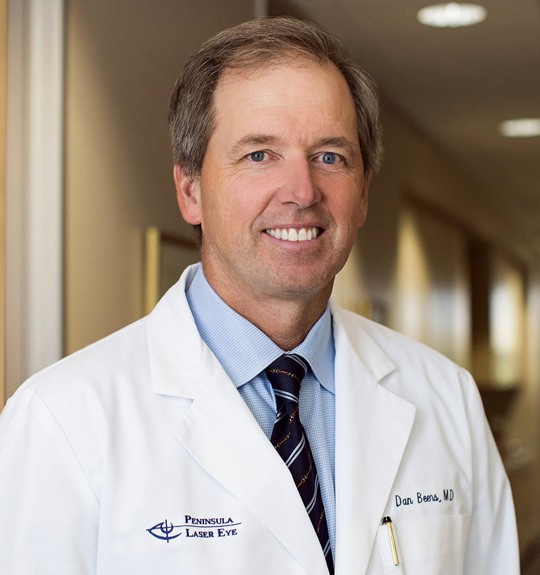 Dr. Dan Beers
Board-certified ophthalmic surgeon, former Chief of Ophthalmology at El Camino Hospital, and a teacher of surgical techniques to Stanford ophthalmology residents.
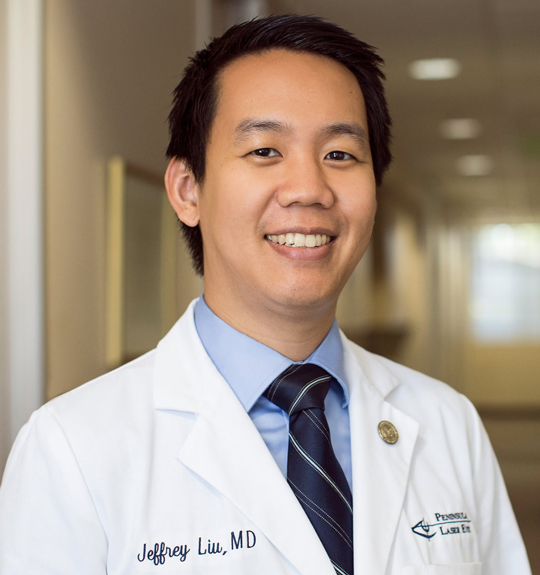 Dr. Jeffrey Liu
Board-certified ophthalmologist with fellowship training in cornea and refractive surgery at UC Irvine, who teaches cataract surgery to Stanford residents at the VA Palo Alto.
Questions patients ask
Is cataract surgery safe?
Cataract surgery is one of the most common, safe and effective types of surgery done in the United States.[3] The vast majority of our patients see a meaningful improvement in their vision.
Do I need general anesthesia?
No. Numbing eye drops are used, and anti-inflammatory and antibiotic drops are applied afterward.
How long does it take, and when can I go home?
The procedure often takes under 20 minutes, and most patients go home the same day. You'll get specific instructions for the days that follow.
Do both eyes need surgery?
Not always. Cataracts can affect one or both eyes and develop at different speeds, and your evaluation shows if and when each eye needs treatment.
When is the right time?
When changes in your vision start to get in the way of daily activities such as reading, driving or watching TV.
Is the consultation complimentary?
Yes. Your cataract consultation is complimentary. Request a time or call (650) 961-2585.
- American Academy of Ophthalmology. "What Are Cataracts?" aao.org
- American Academy of Ophthalmology. "Intraocular Lenses (IOL) for Cataract Surgery." aao.org
- National Eye Institute. "Cataract Surgery." nei.nih.gov
- RxSight. "The Only Adjustable Lens for Cataract Surgery." rxsight.com